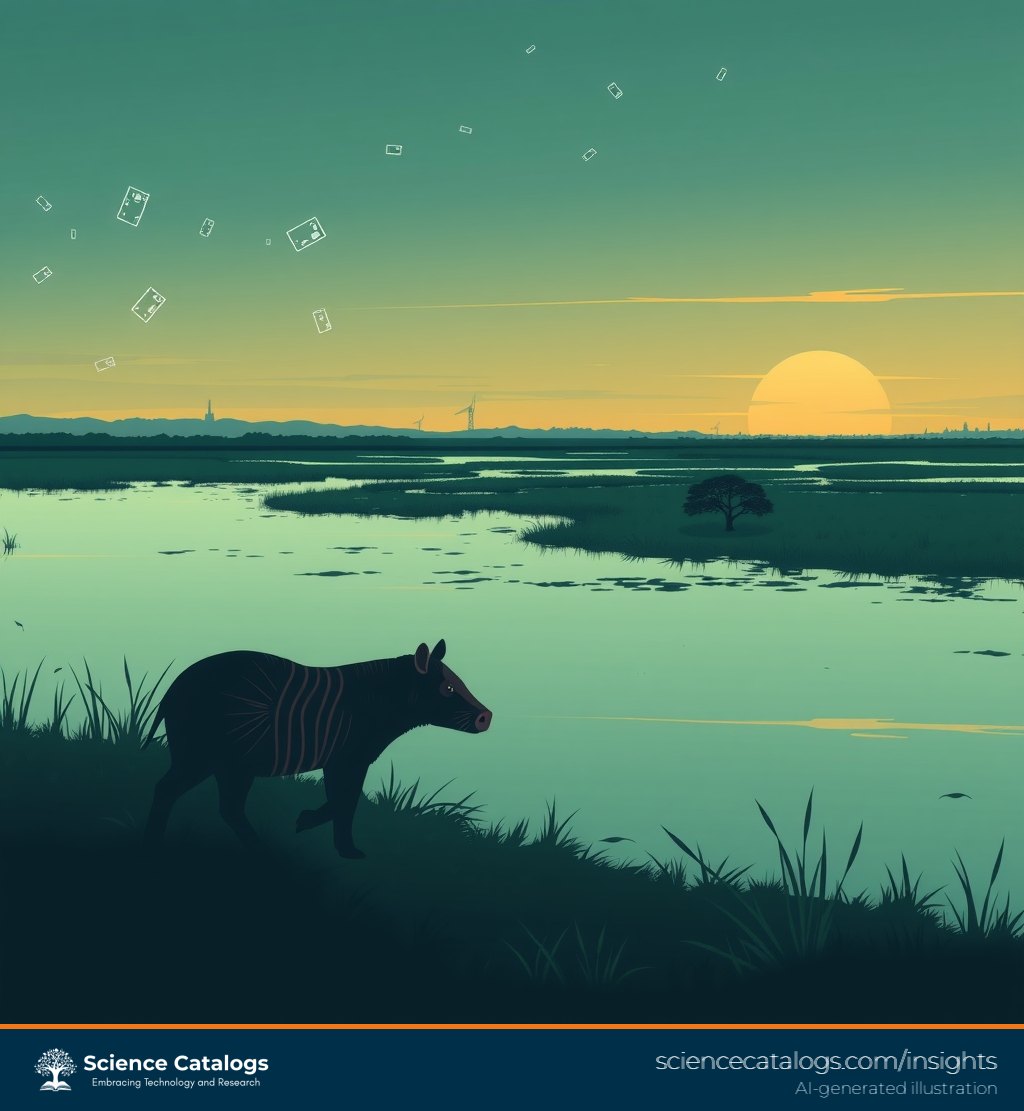
Europe's temperate landscapes were open mosaics, not dense forest 20-million-year ago: review finds
 S
Europe's natural landscape was for more than 20 million years a shifting mosaic of scattered trees, open woodland, grassland and flowering plants, rather than continuous closed-canopy forest. That is the conclusion of a review of palaeoecological evidence led by Aarhus University and published in Biological Conservation. The authors argue that the result challenges the assumptions behind many current reforestation and restoration schemes.
Testing the closed-forest idea
Conservation planning in Europe has long been shaped by what the authors call the closed-forest paradigm. It holds that dense forest with a near-continuous canopy was the continent's natural state before agriculture and settlement. On that view, restoring nature usually means letting trees recolonise open ground or planting new forest.
The team, whose lead author is PhD student Szymon Czyzewski and whose senior author is Professor Jens-Christian Svenning of the Center for Ecological Dynamics in a Novel Biosphere (ECONOVO), set out to test this against the long-term record. Earlier work had tended to focus on more recent periods. This study covers the Miocene, which began about 23 million years ago, up to the pre-industrial era.
Combining independent lines of evidence
No single type of record gives a full picture of past vegetation, so the researchers drew on several. These included fossil pollen and larger plant remains, charcoal from ancient fires, and chemical signatures preserved in the teeth and bones of herbivores. They also used fossil insects and mammals, and ancient environmental DNA recovered from sediments.
Together, these datasets allowed the team to assess not only which vegetation types were present but also how they changed over time and what role large herbivores played. The authors say this multi-proxy approach gives greater confidence than earlier studies that relied on one method.
The pattern was consistent. Mixed landscapes of trees, open ground and flowering plants were typical across the period, and they occurred under temperate conditions similar to those of much of present-day Europe as well as in warmer and colder phases.
The role of large herbivores
The authors attribute the persistence of open habitats largely to grazing and browsing animals. Europe once supported elephants, rhinoceroses, aurochs and bison, which fed on vegetation and disturbed the ground, preventing trees and shrubs from taking over everywhere. That disturbance created space for grasses and wildflowers that would struggle under dense canopy.
Much of this influence has now gone. Many of the large wild herbivores have disappeared, and, according to Czyzewski, traditional extensive grazing vanished from large areas mostly within the last hundred years.
The work also prompts a reassessment of species usually linked to farmland. Larks, jackdaws and the European hamster may have evolutionary roots in open woodland that predates agriculture, and wild poppies may likewise have grown where grazing animals disturbed vegetation. This blurs the sharp line often drawn between forest and open habitat in conservation planning.
Implications for reforestation
The authors do not dispute that forests bring environmental benefits. Their concern is that planting uniformly dense woodland to capture carbon and restore biodiversity could reduce habitat variety for species that evolved in mixed landscapes. Svenning points to Denmark, where, he says, subsidies are granted only for dense forest planting, as an example of practice that may work against native biodiversity.
Instead, the study recommends that restoration prioritise mosaics of woodland and open habitat, including through the return of free-living large herbivores.
What to watch
The source material describes a synthesis of existing palaeoecological evidence rather than a policy trial, so it does not test how mosaic restoration performs against dense planting in terms of carbon storage or species outcomes. Those comparisons, along with how best to reintroduce grazing at scale, are natural questions for follow-up work. The study adds to a growing body of research from the same group suggesting that large animals shaped European ecosystems more strongly than was once recognised.
Source: Scientists discover Europe's ancient forests were nothing like we imagined (ScienceDaily: top science, 7 November 2026).
Image: AI-generated illustration.
Working on this topic? Find a journal for your research or join the discussion on Scholars Post.